Unsubscribe
View in your browser
Royal Society of Edinburgh logo
 
Scotland Africa Horizons - February 2026

Welcome to the second edition of Scotland Africa Horizons, a space to promote and learn about Scottish-African partnerships.

This newsletter is created based on the recommendations from scoping exercises from the RSE’s Africa Working Group in 2023 and 2024, which suggested that the higher education sector would benefit from having a space to promote and learn about Scottish-African partnerships.

The Scotland Africa Horizons newsletter seeks to share content with a focus on collaborative partnership. The newsletter aims to inform stakeholders about joint research, events, opportunities, and collaborations between Scotland and Africa in the higher education sector.

Submit an item

Please note that the newsletter is a pilot project and the RSE relies on quality submissions to continue and succeed. The RSE’s role is to collate and share the information, but the continuation is dependent on sector commitment to support this. If you would like to submit an item for a future edition, please contact international@therse.org.uk.

Share with your network

Readers are encouraged to share this newsletter within their networks. New subscribers can opt-in to Scotland Africa Horizons via the RSE website.


Royal Society of Edinburgh

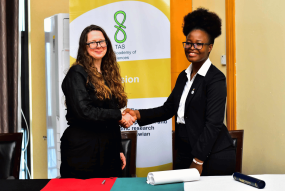
RSE signs landmark agreement with The Academy of Sciences Malawi (TAS)

Scotland and Malawi signed a landmark agreement in February 2026 to promote and strengthen cooperation between researchers across a diverse field of disciplines. It is the first agreement between TAS and any other nation. It is also the first agreement between the RSE and any African nation. TAS was inaugurated in 2021.

Photo: Trevor Nyondo

RSE Workshop on Inclusivity in International Partnerships

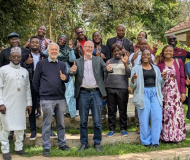
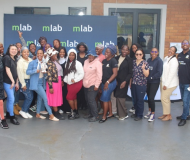
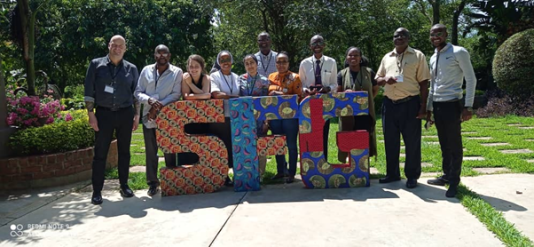
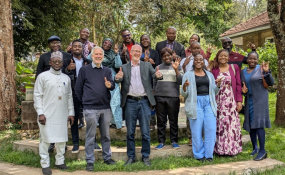
Following on a series of roundtable discussions held at the RSE in 2025, the RSE Africa Working Group held this workshop in January 2026 to explore how researchers across disciplines and higher education stakeholders are advancing inclusivity in international partnerships. Guided by Fakunle’s (2024) Centrality framework, the focus was on how the ARC model of Active involvement, Recognition, and Contribution can help identify and dismantle barriers to equitable collaboration.

RSE Research Awards across Africa

Announced on 25 February, the RSE’s 2025 Research Award Autumn round awarded three projects across Africa, two in Malawi and one in Kenya. Read more about these projects and all other awardees.

The RSE Research Awards Spring round is currently open until the beginning of April.


University of Dundee

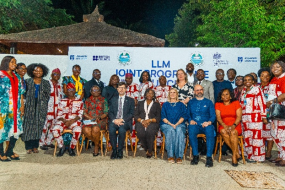
First Joint LLM Programme between UK and Nigeria

The Joint LLM is founded on the shared commitment of Dundee Law School and Faculty of Law UNILAG to making a truly equitable partnership based on co-creation, parity of esteem and accessibility. Find out more.

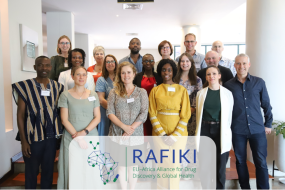
EU-Africa Research Infrastructure Alliance to Foster Infectious Disease research, Knowledge sharing and Innovation (RAFIKI)

RAFIKI is a consortium of drug discovery experts across Europe and Africa with a shared mission: to bring opportunities and strengthen capacities for African drug discovery researchers. Find out more.


University of Glasgow

Evidence cultures in Post-apartheid policy making

BA funded 2025-6: ‘Evidence cultures in Post-apartheid policy making’. Prof Phil Harrison, Wits University leads this project, focusing on policy shaping former homelands in South Africa.

Image: rapid urbanisation in Mpumalanga (Paula Meth, 2024).

Public Engagement on Decoloniality through the Healing Histories Initiative

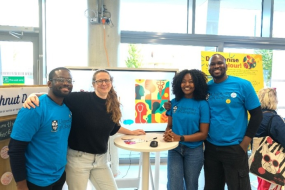
At Explorathon 2025, researchers from the Universities of Glasgow and Edinburgh, supported by the Africa Working Group of the Royal Society of Edinburgh, engaged the public on decoloniality through an exhibition as part of the Healing Histories Initiative.


The exhibition explored core decolonial concepts, highlighted African contributions to modern medicine, and showcased decoloniality efforts across Scottish universities. The overwhelmingly positive feedback demonstrated keen public interest and the need for decoloniality efforts to shift from being predominantly academic to more community-focused conversations.

The MalDent Project - a Scottish Government-funded project

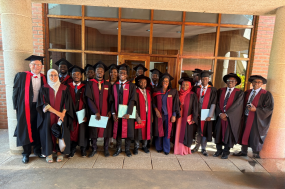
Partnership working between Kamuzu University of Health Sciences, University of Glasgow, and Malawi's Ministry of Health, has established Malawi’s first dental degree programme and a National Oral Health Policy.

Photo: Malawi’s first home-trained dentists, pictured after graduation with some staff members

Sustainable Futures Global Network (SFG): The Scottish community interest company re-writing international partnership and participation practices

A brief background on the SFG will introduce their latest project, which is a suite of accessible, partnership-based courses on key pillars of ethical, relational, and sustainable development practice. Read more.

Democratising spywatching: public oversight of intelligence-driven surveillance in Southern Africa

The Scottish Universities Press has just published an edited volume, exploring public oversight of digital surveillance for intelligence purposes. It examines cases in eight Southern African countries where such oversight either succeeded, failed, or achieved mixed outcomes. 


James Hutton Institute

New potato varieties will help to battle major pest in Kenya

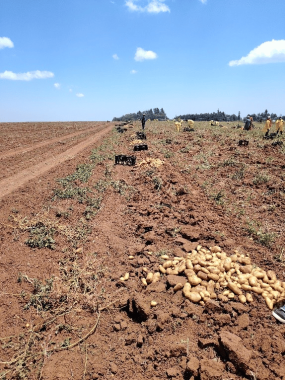
A collaborative project between the James Hutton Institute, University of St Andrews and the International Institute for Tropical Agriculture has led to the release of two new varieties of potato, Glen and Malaika, that combine resistance to a devastating introduced pathogen with traits required by smallholder farmers in the region. Read more.

Photo: Harvest of the first field generation of seed tubers at Kisima Farms in Kenya


Royal Botanic Garden Edinburgh

Fire management and Conservation in Madagascar

Managing fire well in high-biodiversity landscapes such as Madagascar is a major conservation challenge, particularly when fire is a central livelihood and land-management tool for local communities. Past fire management approaches have often failed because they relied on punitive measures, including fines and arrests.

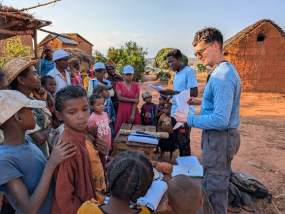
Responding to a need to understand why people use fire, the Fitantanana Maharitra Holovain-jafy project—a partnership between Malagasy and UK institutions including the Royal Botanic Garden Edinburgh —identified the socio-economic drivers behind community fire use, providing evidence to support fire management strategies that incorporate community needs in ways that are more effective, equitable and sustainable.


Robert Gordon University

Micro-Entrepreneurship and Organisational Development in informal settlements

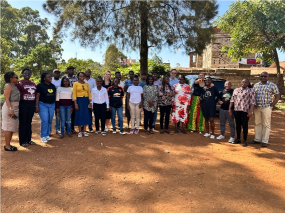
A long-standing collaboration, stemming from several related research projects, between 15 Nairobi-based community organisations and RGU researchers Dr Natascha Mueller-Hirth, Prof Stephen Vertigans and Dr Imaobong James resulted in capacity building and train-the-trainer workshops.  Held in January 2026, the workshops were co-created by Kenyan and RGU contributors to strengthen organisational development and micro-entrepreneurship. The project is also developing a toolkit showcasing the organisations’ work and best practice, a range of training materials to be delivered by Kenyan CBOs/NGOs and a film.


Her-AI-Path advances gender equality in AI

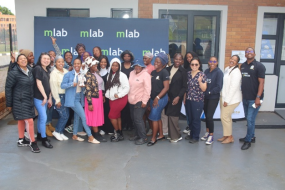
This British Council-funded project, led by Dr Poh Yen Ng, benefited more than 250 women in South Africa. The hands-on workshops have been held in Johannesburg and various townships, including Mamelodi, Limpopo, Kimberley and Pietermaritzburg, inspiring women in underprivileged communities and fostering inclusive innovation. Read more


University of St Andrews

Go back and validate it: Creating Synergy Between Indigenous Practices and Scientific Knowledge (ISIPSK)

ISIPSK advances inclusive decolonial research by returning findings to communities. Validation began with Western Region fisherfolk and continues across Ghana, culminating in a public report launch on 3 February.

New student exchange between St Andrews and Stellenbosch

St Andrews and Stellenbosch have enhanced their longstanding link through the development of a new undergraduate exchange programme. Read more.


University of Stirling

Professor Sean Semple Trains African Lung Health Researchers

Prof Sean Semple led Air Quality Monitoring training at Kenya's ATS-PATS MECOR course, empowering 50+ early career researchers to address respiratory health challenges across sub-Saharan Africa.


University of Strathclyde

Global Health Research Group on Adolescent Health and Wellbeing in Malawi

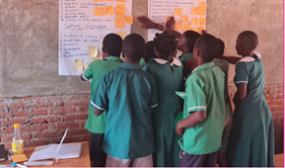
This 4-year NIHR funded project between University of Strathclyde and Malawian partners is examining the impact, and codesigning solutions for adverse childhood experiences, sexual and reproductive health, water, sanitation and hygiene and wellbeing with early adolescents. Read more.


Political Parties in Africa and Democracy

The European Research Council has awarded a Synergy Grant worth €9.69 million to a team, led by Robert Mattes at the University of Strathclyde (and including academics from Bristol, Reading and the Kwame Nkrumah University of Science and Technology) to study political parties across 25 African countries. Read more.


Scotland - Malawi Partnership

New Leadership

Dr Elita Chamdimba, member of RSE’s Africa Working Group, recently joined Malawi-Scotland Partnership’s (MSaP) Board. This leadership role offers her a new platform to advance equitable, collaborative Scotland–Africa partnerships.


University of the West of Scotland 

Book publication

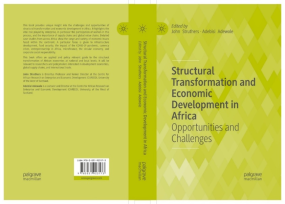
The Centre for African Research on Enterprise and Economic Development (CAREED) published their third book edited by Emeritus Professor John Struthers and Dr Adebisi Adewole, CAREED Director. The book is titled "Structural Transformation and Economic Development in Africa: Opportunities and Challenges”, the edited volume contains 15 chapters on a range of topics will be out to the public in hard copies in February 2026.


Collaborations and Partnerships

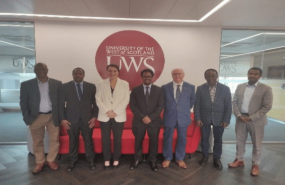
The Ethiopian Ambassador to the United Kingdom of Great Britain and the Northern Irelands, Biruk Mekonnen Demissie recently paid a visit to CAREED. The University's Vice Principal for Internationalisation, Stephanie Piticas, conversed with the Ambassador on a range interests and potential opportunities between UWS and Ethiopian institutions. Areas of focus included deepening teaching and learning quality, applied research with impacts, and graduate employability. 


Thanks to all who have contributed to this edition of Scotland Africa Horizons.

This is a new project and your feedback is valued. What did you think of this email?

It was helpful

Somewhat helpful

It wasn’t helpful

Did someone forward you this email?
Sign up

View in your browser | Forward to a friend | Unsubscribe

© The Royal Society of Edinburgh | Registered Charity No SC000470 | Privacy policy
 

The Royal Society of Edinburgh
22-26 George Street
Edinburgh
EH2 2PQ

 Facebook  X / Twitter  Linkedin  Instagram  Youtube